








AIDEVI Wellness Guide
nmn Powder vs Capsules vs Sublingual: Accuracy, Stability, and Convenience
Powder, capsules, and sublingual NMN are not three proven tiers of effectiveness. Powder is measured before use, while capsules and tablets package a set unit; sublingual describes a way to take a product, not a powder-versus-capsule category. Compare the labeled amount, measuring routine, product-specific storage directions, and evidence for the exact route—not a broad promise that one format absorbs best.
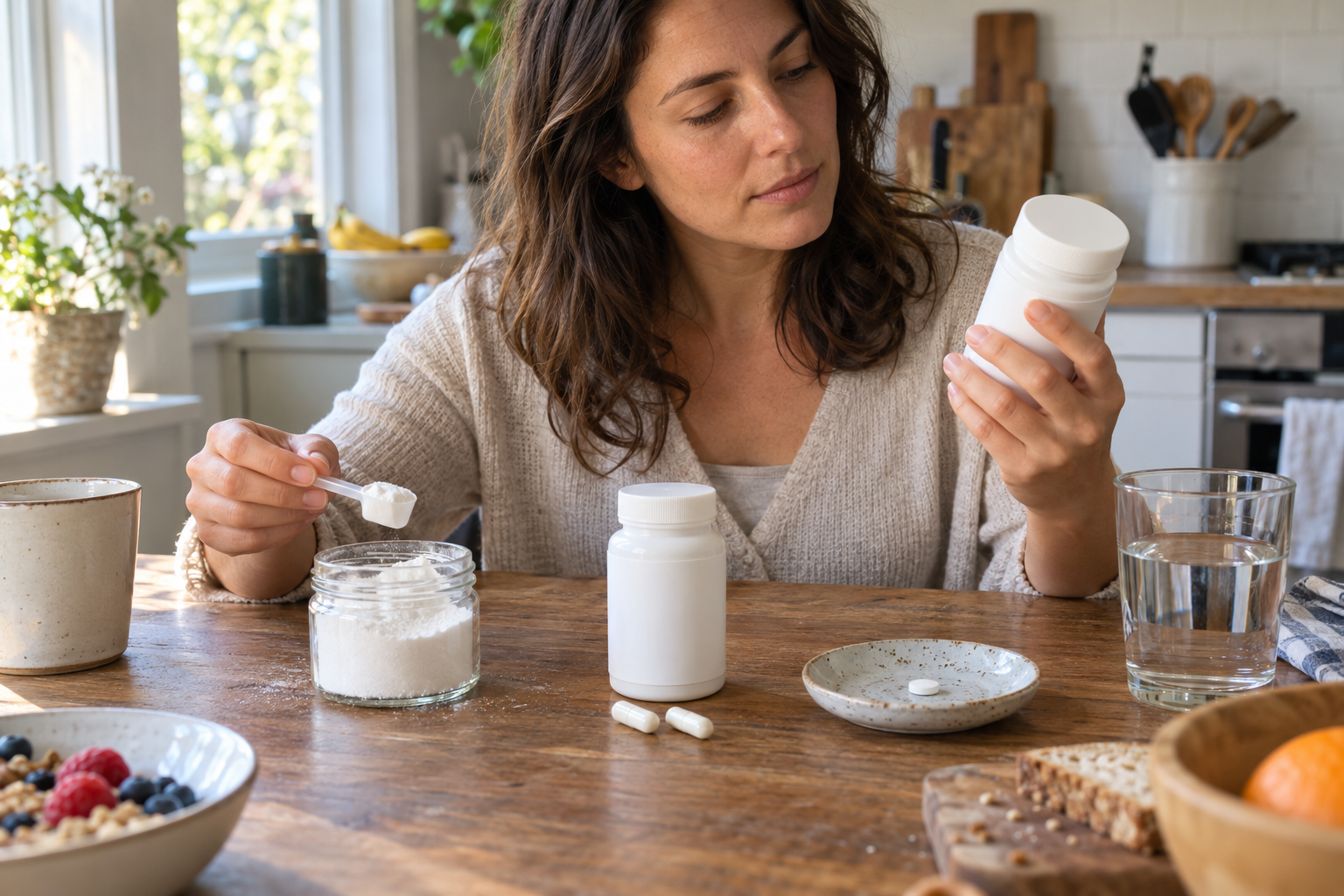
Choose capsules for a pre-measured unit and easier packing, powder when you need flexibility and can measure it as directed, and a sublingual product only if its label specifies that route and you prefer it. A small 2026 human study found differences in early NMN metabolites, not proof that sublingual NMN produces better long-term outcomes.
Content
Are powder, capsules, and sublingual really three formats?
Not quite. Powder describes the material before it is portioned. A capsule or tablet is a dosage form that packages an amount. Sublingual describes administration: a product is held under the tongue to dissolve. A tablet can be used by a sublingual route, and a powder may be sold for a route stated on its own label. The terms overlap, so compare the product’s actual instructions rather than treating the names as equivalent categories.
That distinction prevents a common leap in online comparisons: a study of one sublingual tablet does not prove that loose powder held in the mouth behaves the same way. Nor does opening a capsule automatically turn it into a sublingual product. The formula, unit, excipients, dissolution instructions, and route used in research all matter.
| What you are comparing | Practical difference | What not to assume |
|---|---|---|
| Powder | You portion each use with the supplied measure or other method stated on the label. | A scoop volume or household spoon is a fixed milligram amount for every product. |
| Capsule or swallowed tablet | The product packages a unit; the serving may still contain more than one unit. | The milligrams per capsule are always the same as milligrams per serving. |
| Sublingual use | The product is used under the tongue according to its own route and dissolve instructions. | The route alone guarantees faster absorption or a better health result. |
For U.S. dietary supplements, labeling rules describe a serving size using a term appropriate to the product form, such as capsules, packets, or teaspoonfuls, and provide conventions for declaring amounts per serving [5]. Use those fields to compare like with like: milligrams per capsule, per serving, per packet, or per gram are different bases.
Which format makes the serving easiest to measure?
Capsules are often simpler when you want a countable unit: read the amount per capsule, then check how many capsules make one serving. Powder allows more flexible portioning, but the measuring step becomes part of your routine. Follow the product’s directions and use its supplied measuring method. Do not substitute a kitchen teaspoon for a weight-based measure or guess from how full a scoop looks.
A capsule can reduce the number of measuring steps; it cannot, by its shape alone, verify what a lab measured in that batch. A powder can make portion size adjustable; it does not make an estimate accurate. A dissolvable tablet can be pre-portioned too, but check whether the label specifies swallowing or holding it under the tongue. For any format, read the lot, expiration date, serving size, and directions on the current package.
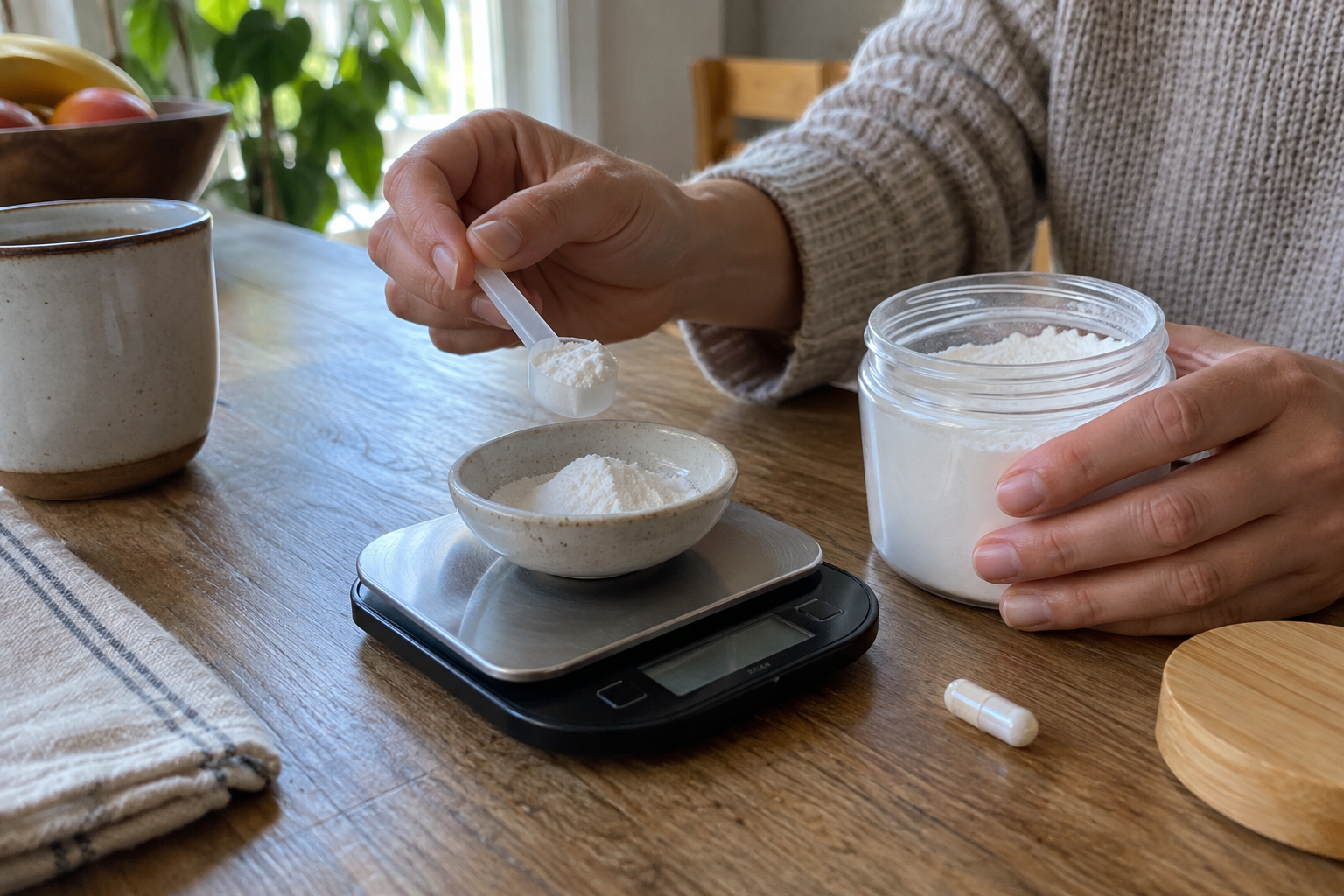
A 2024 laboratory analysis bought and tested 18 NMN products in several forms: five powders, eleven capsules, one tablet, and one liquid. Measured NMN content ranged from not detected to 99.2% of sample weight, and the difference from adjusted label claims ranged from −100% to +11.2% [2]. This was a small snapshot of products purchased in 2023, not a controlled comparison showing that powder or capsules are inherently more accurate. It does show why format is not a substitute for checking the product and its quality evidence.
Before comparing labels, write down three separate numbers: NMN per unit, NMN per serving, and the number of servings in the container. AIDEVI’s NMN 18000 product information, for example, lists 300 mg of NMN per capsule and 600 mg per two-capsule serving, alongside other formula ingredients. That is an example of label arithmetic, not a claim that one serving or format is right for every person. Check the current physical label before use.
If the amount or sample is unclear, the next step is not to infer potency from a powder’s appearance or a capsule’s size. Use AIDEVI’s guide to reading an NMN certificate of analysis to check whether a report matches the product, lot, sample type, method, units, and result you are evaluating.
Does sublingual NMN work better than a swallowed product?
A June 2026 randomized crossover study offers an early human comparison, but its result is narrower than many marketing summaries suggest. Fourteen healthy adult men enrolled, and thirteen completed both periods for the efficacy analysis. Each participant used the same 250 mg β-NMN tablet once by swallowing it and once by holding it under the tongue for three minutes; researchers collected blood samples over 60 minutes [1].
The study found higher early exposure to two terminal metabolites, 2PY and 4PY, after sublingual use. It did not find significant differences between routes in blood NMN, nicotinamide, or NAD+ concentrations during that measurement period. The authors also noted that the saliva was swallowed after dissolving, so the study could not isolate how much of the result came from true absorption through the mouth. It measured short-term pharmacokinetics, not a lasting health outcome.
The sample was small and limited to healthy young men, follow-up lasted one hour, and the paper calls for larger studies and clinical outcomes. The authors disclosed employment with Meiji Holdings. Those details do not erase the result; they define how far it can be taken. It is not evidence that every sublingual powder beats every capsule, nor that a higher metabolite measurement means better everyday results.
A different 2022 clinical trial tested NMN powder that researchers packed into capsules before participants took it. That design can inform questions about the studied formula and dose, but it does not isolate “powder versus capsule” as the cause of an outcome [3]. AIDEVI’s NMN guide to human research, quality, and safety explains why study formulation, participant group, and measured endpoint matter when translating results to a product choice.
Which NMN format is more stable after opening?
There is not enough evidence to rank every powder, capsule, or sublingual product by format alone. Stability depends on the specific formula, package, seal, storage conditions, expiration date, and how the container is handled. A shell does not prove a capsule remains potent, and a jar of powder is not automatically unstable.
A laboratory study of β-NMN degradation in aqueous solution found that conditions including temperature and pH influenced degradation in that test system [4]. A solution experiment does not directly compare retail capsules with retail powder in their original packages. Do not use it to predict a particular bottle’s shelf life or to override the manufacturer’s storage instructions.
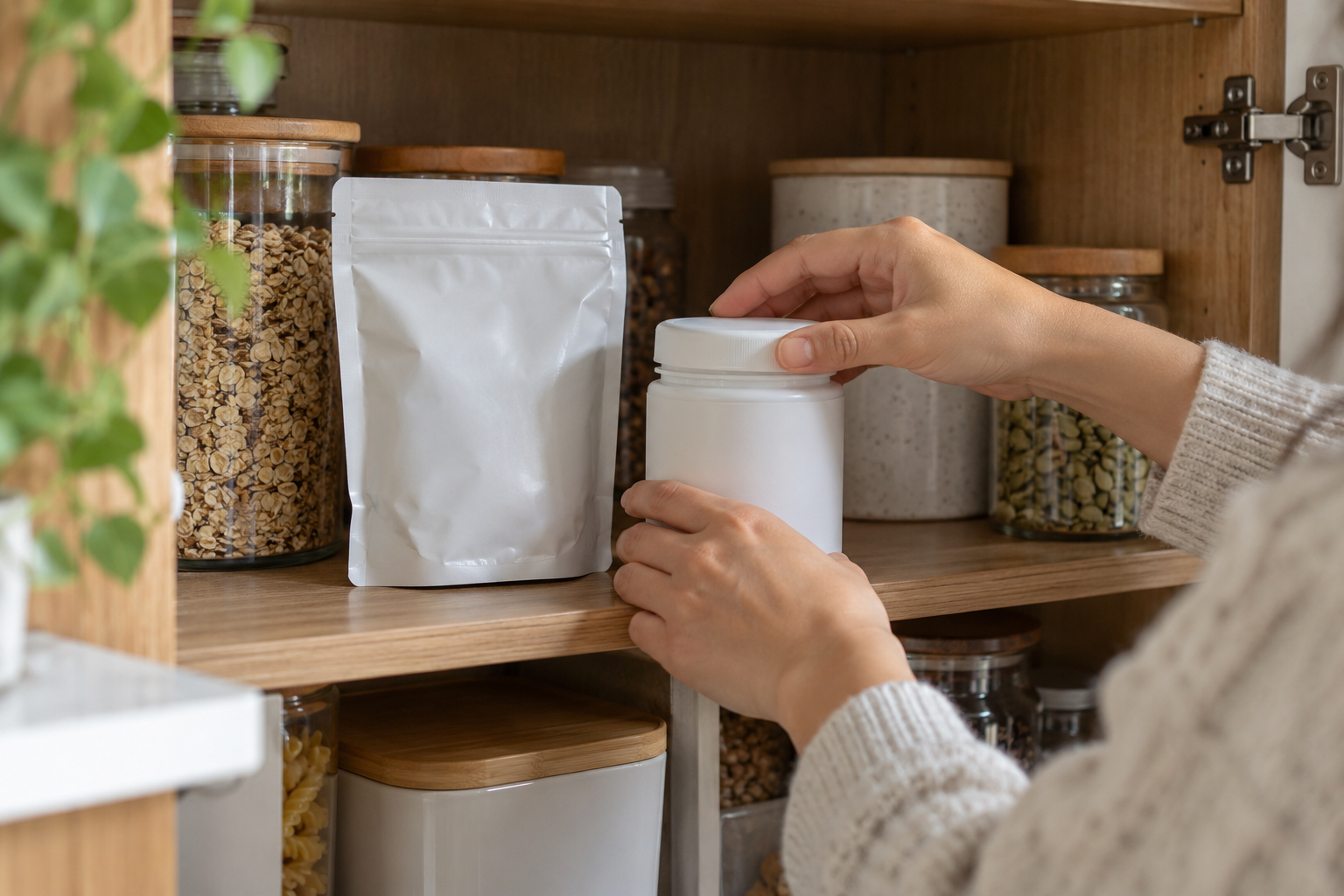
A practical handling routine is simple: keep the product in its original container, close it promptly, use a clean and dry scoop if it comes with one, and follow the label’s temperature and after-opening directions. Keep it away from obvious heat and moisture sources unless the product instructions say otherwise. If you have questions about refrigeration or travel storage, ask the manufacturer rather than applying a rule from a different product.
For batch-specific questions, ask whether the available report tested a raw ingredient, a blend, or the finished product and whether the lot matches yours. The AIDEVI guide to why NMN feels different from person to person also separates product details from personal response; a format choice alone cannot explain every change someone notices.
How do you choose a format for your routine?
Start with the handling task you can repeat, then check whether the label and quality documentation answer your questions. Convenience is a legitimate reason to choose a format. It is not a shortcut for deciding which route has stronger clinical evidence.
| Could fit if… | Check before choosing | Consider another option if… |
|---|---|---|
| Capsule or swallowed tablet: you prefer a countable unit and less measuring. | Amount per unit, units per serving, other active ingredients, and whether swallowing the unit works for you. | You have difficulty swallowing capsules or need a different serving structure. |
| Powder: you value portion flexibility and can follow its measuring directions consistently. | Whether the directions specify weight or a supplied scoop, plus storage and resealing instructions. | Measuring, handling an open container, or taking powder away from home is inconvenient. |
| Sublingual product: you prefer a dissolve-under-the-tongue routine and the product is labeled for it. | Exact use instructions and whether claims about superiority go beyond the available study. | You would choose it only because an advertisement promises faster or stronger results. |
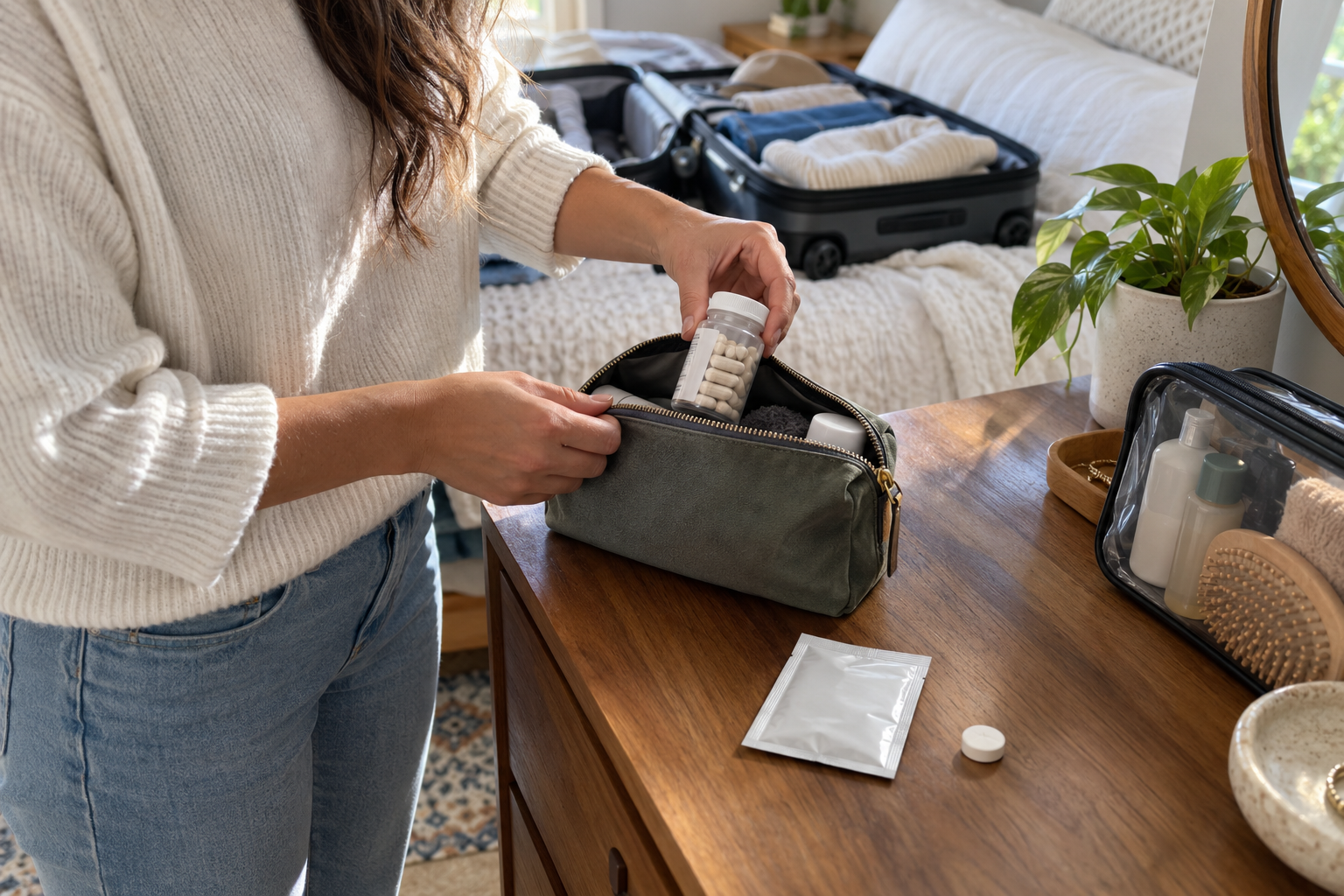
Before buying, check these six items:
- The exact ingredient and whether the product is a single ingredient or a blend.
- NMN amount per capsule, tablet, packet, or gram, and amount per full serving.
- The route and instructions the product label actually specifies.
- The lot, expiration date, storage directions, and package type.
- Whether a COA identifies the tested sample, lot, method, units, and measured result.
- Cost per labeled serving, not only the total milligrams printed in a product name.
If a detail is missing, you can ask the seller: “For this product and lot, what NMN amount is in each unit and in the complete serving? Was the report performed on the finished product or raw material? Which route does the label specify, and what are the storage directions after opening?” Keep the response with the product information. An unanswered question limits what you can verify; it does not by itself show that a product is unsafe or counterfeit.
For safety questions, review the current label and AIDEVI’s NMN effects and side-effects guide. If you are pregnant or nursing, take medication, manage a medical condition, or notice a persistent or concerning reaction, ask a qualified healthcare professional before changing a supplement routine.
Conclusion
The useful comparison is not “which format wins?” It is “which labeled product can I measure, store, and use consistently—and what evidence supports its exact route?” Powder offers portion flexibility, capsules and tablets package units, and sublingual describes how a product is taken. Check the serving basis and batch evidence first. Treat early metabolite findings as research, not a promise of better health outcomes.
Frequently Asked Questions
Does NMN powder absorb faster than capsules?
There is not enough direct human evidence to rank loose powder and capsules as universal winners. A study’s ingredient, formulation, route, dose, and endpoints all matter. Do not translate the texture of a powder into an absorption claim.
Are capsules more accurate than NMN powder?
Capsules provide countable units, which can simplify portioning, but the format alone does not verify the amount in a batch. Powder offers flexibility but adds a measuring step. Compare the per-unit and per-serving label amounts, instructions, lot, and relevant test report.
Does sublingual NMN have proven better bioavailability?
One small 2026 crossover study found higher early levels of two terminal metabolites after sublingual use, but no significant route difference in measured blood NMN, nicotinamide, or NAD+ over the study window. It did not establish a lasting clinical advantage.
Can I open a capsule and use the powder under my tongue?
Do not assume that opening a capsule makes it suitable for sublingual use. The product may not be designed or labeled for that route, and the 2026 study tested a specific tablet under a specific protocol. Follow the directions for the exact product and ask its manufacturer if they are unclear.
Does NMN powder need refrigeration?
Use the storage directions on the product you have. A laboratory solution study cannot determine the right storage conditions for every commercial powder or capsule. Keep the container closed and use the stated temperature and after-opening instructions.
References
- [1] Wakabayashi J, Higashi S, Morifuji M. Sublingual NMN administration increases early circulating terminal catabolites 2PY and 4PY compared with oral administration in healthy adult men. Scientific Reports. 2026;16:27464.
- [2] Kuhaudomlarp S, et al. Testing the amount of nicotinamide mononucleotide and urolithin A as compared to the label claim. GeroScience. 2024;46:5075–5083.
- [3] Yi L, et al. The efficacy and safety of β-nicotinamide mononucleotide supplementation in healthy middle-aged adults: a randomized, multicenter, double-blind, placebo-controlled, parallel-group, dose-dependent clinical trial. GeroScience. 2023;45:29–43. Published online December 8, 2022.
- [4] Xiang DH, et al. Degradation kinetics of β-nicotinamide mononucleotide based on reliable HPLC quantitative method. China Journal of Chinese Materia Medica. 2023;48(24):6635–6644.
- [5] Electronic Code of Federal Regulations. 21 CFR § 101.36: Nutrition labeling of dietary supplements. Current eCFR reviewed September 2026.
This article is for general educational purposes only and is not medical advice. These statements have not been evaluated by the Food and Drug Administration. This product is not intended to diagnose, treat, cure, or prevent any disease. Consult a qualified healthcare professional before starting any new supplement, especially if pregnant, nursing, taking medication, or managing a medical condition.
