








nmn and TMG: Why People Combine Them and How to Think About Fatigue
People often pair NMN with TMG after reading that both are connected to cellular metabolism or methylation. That biochemical overlap does not establish that TMG is a necessary NMN companion, however, and feeling tired after starting a supplement does not identify the cause. If fatigue appears, pause before adding another product: document the timeline, review the labels and other routine changes, and seek medical advice when symptoms persist or feel severe.

What matters most: There is no established rule that everyone taking NMN must also take TMG. TMG participates in a real methyl-donor pathway, but that fact does not show that NMN depletes methyl groups in ordinary users or that TMG prevents fatigue. Track what changed and when; do not stack new supplements to self-diagnose a symptom.
Content
- Why do people combine NMN and TMG?
- Does NMN use prove that you need TMG?
- What does TMG actually do?
- How can you check fatigue safely?
- What is the next step for different situations?
- Frequently asked questions
Why do people combine NMN and TMG?
The pairing usually comes from a plausible-sounding chain of ideas. NMN is studied as a precursor in NAD+ biology. TMG, also called betaine, can donate a methyl group in one pathway that converts homocysteine back to methionine. Because some NMN metabolites are methylated and excreted, online discussions sometimes jump from “these processes share a connection” to “NMN uses up methyl groups, so every user should replace them with TMG.” The second statement is a much stronger claim than the pathway itself supports.
People also describe personal routines on forums: taking NMN and TMG together, separating them by time, changing to alternate-day use, or adding TMG after noticing fatigue or brain fog. Those reports are useful for understanding what questions consumers have. They cannot show whether a supplement caused a symptom, whether a different product or routine was responsible, or whether TMG improved it. The person may have changed several things at once, and online posts rarely include a comparison group, verified product contents, or clinical assessment.
That distinction matters when you are trying to decide what to do next. A symptom that starts after a new supplement deserves attention, but timing alone is not a diagnosis. Sleep disruption, an infection, stress, a medication change, food intake, training load, or an unrelated health condition can overlap with a supplement change. For a broader look at why experiences differ, see AIDEVI’s guide to why NMN may feel different from person to person.
Does NMN use prove that you need TMG?
No. A biochemical hypothesis can motivate research, but it is not the same as a demonstrated deficiency, a proven side effect, or evidence that routine TMG supplementation prevents fatigue. The human studies below answer narrower questions than social posts often imply.
| Human study | What it examined | What it cannot establish |
|---|---|---|
| Kim et al., 2022 | A 12-week randomized trial in 108 older Japanese adults, using 250 mg NMN daily in morning or afternoon groups and assessing outcomes including fatigue, sleep, and physical performance.[1] | It did not test whether TMG is required, whether TMG prevents fatigue, or whether every age group responds similarly. |
| Irie et al., 2020 | A small safety study gave single NMN doses to 10 healthy men and monitored them for five hours, including measurement of metabolites.[2] | A short single-dose study is not evidence of long-term methyl-group depletion, a chronic fatigue mechanism, or a need to add TMG. |
Neither study compares NMN alone with NMN plus TMG as a fatigue-prevention strategy. That is the key evidence gap for the question in this article. The available pathway literature explains how betaine can contribute to homocysteine remethylation; it does not establish that a generally healthy NMN user has low methylation capacity or needs a supplement to correct it.[3]
So avoid treating a theory as a personal test result. Fatigue does not tell you that homocysteine is high, that methylation is “blocked,” or that TMG is the missing piece. Testing and treatment decisions belong with a qualified clinician who can consider symptoms, health history, medications, and appropriate labs rather than infer a deficiency from a social-media checklist.
What does TMG actually do?
TMG stands for trimethylglycine, a form of betaine. In the betaine-homocysteine methyltransferase (BHMT) pathway, betaine can donate a methyl group as homocysteine is converted to methionine. A meta-analysis of betaine supplementation studied homocysteine outcomes; it was not a trial of NMN users or a test of fatigue relief.[3] This is why it is more accurate to say that TMG participates in a defined biochemical pathway than to call it a universal “methylation fix.”
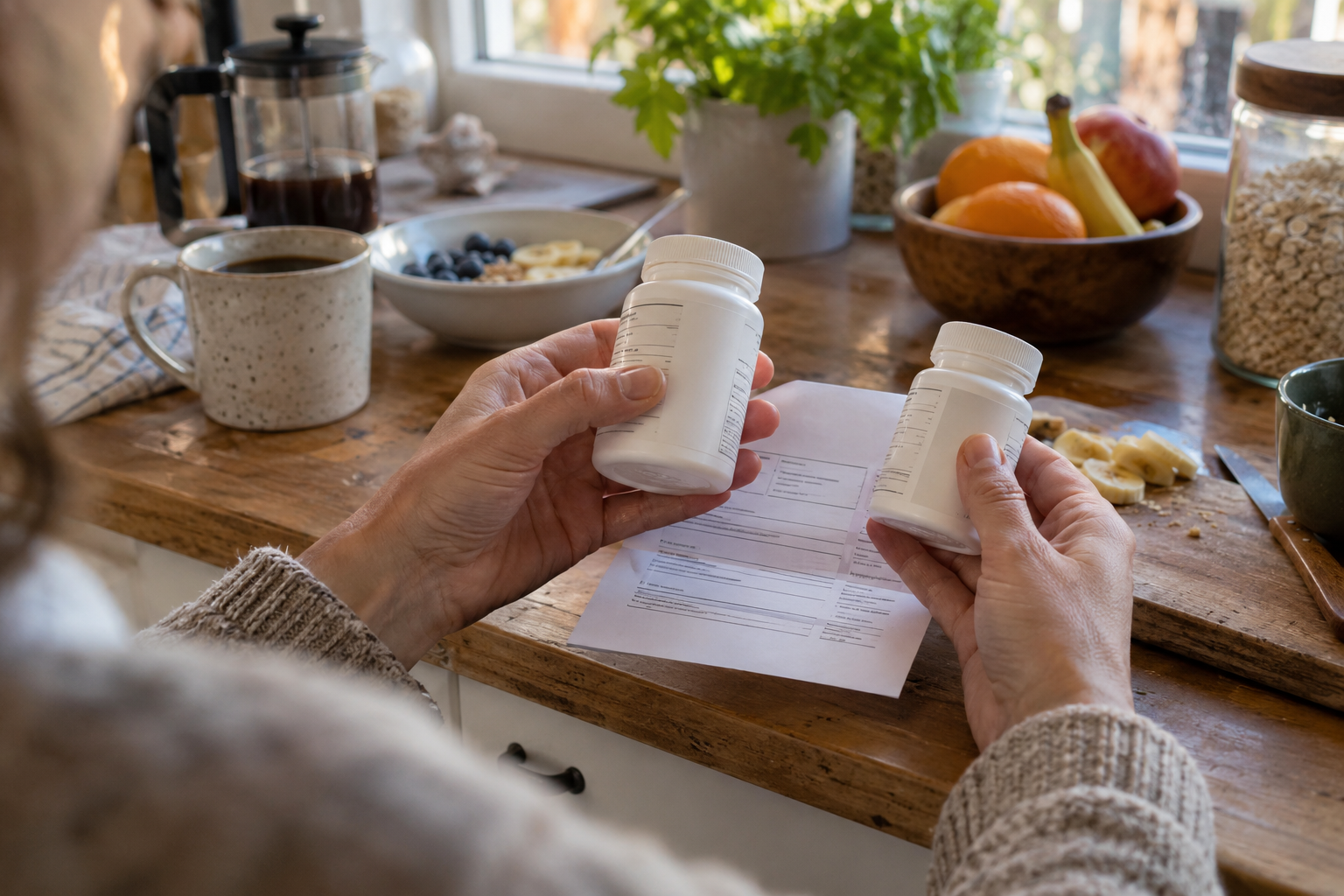
Product names can also create confusion. “Betaine” may refer to betaine anhydrous/TMG in a dietary supplement, while betaine hydrochloride (Betaine HCl) is a different product form. Prescription betaine products are used for specific medical indications under professional care; they should not be treated as interchangeable with a general wellness supplement. Read the full Supplement Facts panel, serving size, other active ingredients, and warnings. If a label is unclear, take a photo or bring the container to a pharmacist or clinician rather than guessing from the front label.
If your question is about when or how TMG is commonly discussed, AIDEVI already has a separate TMG timing and safety guide and an explainer on what TMG is and what its pathway role means. Neither should be read as a reason that all NMN users need to add it. This article focuses instead on how to reason through fatigue without layering products or making a diagnosis yourself.
How can you check fatigue safely?
Use this checklist to prepare a clear account of what changed. It is not a substitute for medical advice and it does not tell you to start, stop, or change a dose. Its purpose is to reduce guesswork and make a conversation with a healthcare professional more useful.
- Write down the sequence. Record when fatigue began, when each product was started or changed, the serving shown on the label, time of day, missed days, and when symptoms improve or worsen. Include the product name, lot or batch number if available, and a clear photo of the Supplement Facts and other ingredients. Do not rely on memory alone.
- Capture the rest of the context. For several days, note sleep duration and quality, caffeine and alcohol, meals and hydration, recent illness, unusual exercise, travel, stress, and any prescription or over-the-counter medicine changes. These are possible context clues, not proof of a cause. General health references list many potential reasons for fatigue, which is why the supplement timeline should not be considered in isolation.[4]
- Do not add several new variables. Adding TMG, methylfolate, B12, another “methylation support” product, and an energy supplement at once makes it harder to know what happened and may create new risks or interactions. If you are considering any change, first check with a qualified health professional, especially if you take medication, have a diagnosed condition, or are pregnant or breastfeeding.
- Review the whole product, not just the headline ingredient. Check for stimulants, botanicals, vitamins, allergens, serving directions, and warnings. If the bottle is a blend, an apparent NMN or TMG reaction may involve another ingredient, a product-quality issue, or a different factor. Keep the container and purchase details in case a professional needs them.
- Set a clear threshold for help. Contact a clinician or pharmacist if fatigue is persistent, recurrent, unexplained, interferes with daily life, or began alongside another concerning symptom. Do not stop or adjust prescribed medication on your own. Seek urgent care for severe or rapidly worsening symptoms, fainting, confusion, chest pain, or difficulty breathing.

If a healthcare professional agrees that a routine change is appropriate, follow their instructions and record one change at a time. Do not deliberately restart a product that caused a serious reaction just to see whether symptoms return. If symptoms are mild but confusing, the goal is not to force an at-home experiment; it is to preserve enough information for a safer decision. AIDEVI’s NMN symptom and next-step guide covers fatigue, brain fog, and dizziness in more detail, while its tracking guide explains how to keep observations separate from conclusions.
What is the next step for different situations?
| What is happening? | A safer next step | Avoid |
|---|---|---|
| You are considering TMG because a forum says it is required with NMN. | Ask what evidence supports the claim for your situation; review the label and discuss personal risks with a clinician or pharmacist if relevant. | Treating an online routine as a prescription or assuming a pathway explanation proves personal need. |
| Fatigue appeared after you changed a supplement routine. | Document timing, products, and other changes; contact a professional if it persists, recurs, or affects normal activities. | Adding multiple supplements to counteract the symptom or changing prescribed medication yourself. |
| Symptoms are severe, rapidly worsening, or include red flags. | Seek prompt medical assessment or emergency help as appropriate. | Waiting for a supplement experiment to establish the cause. |

This approach is less dramatic than trying to “balance” a supplement stack, but it produces better information. Fatigue is a symptom with many possible explanations. A qualified professional can decide whether evaluation is warranted and whether any supplement or medication change makes sense for your history. AIDEVI’s NMN research and safety overview provides broader background; this page is deliberately narrower and does not make an individual treatment recommendation.
Conclusion
People combine NMN and TMG because their biology appears connected in online explanations, but a plausible mechanism is not proof that TMG is necessary or that it will prevent fatigue. The human NMN studies cited here did not test a required NMN-plus-TMG regimen. If fatigue follows a change, write down the timeline, review every ingredient, avoid introducing several new products, and ask a healthcare professional when symptoms persist or are concerning. Let evidence and your individual health context—not a forum stack—guide the next decision.
Frequently asked questions
Does everyone taking NMN need TMG?
No universal requirement is established by the human evidence discussed here. TMG has a biochemical role, but that alone does not show that every NMN user needs supplemental TMG. Personal supplement decisions should account for health history, medications, the actual product, and professional advice when needed.
Can TMG prevent fatigue from NMN?
The cited human NMN trials did not test TMG as a fatigue-prevention add-on, so this article cannot say that it does. Fatigue can have many causes; adding TMG is not a reliable way to identify or treat one.
Does fatigue mean I have a methylation problem?
No. Fatigue by itself cannot diagnose a methylation problem, a high homocysteine level, or a nutrient deficiency. A clinician can decide whether symptoms and history call for testing.
Is TMG the same as betaine HCl?
They are different product forms and should not be assumed interchangeable. Check the ingredient panel and ask a pharmacist or clinician if the label or intended use is unclear.
When should I get medical help for fatigue?
Seek professional advice for persistent, recurring, unexplained, or disruptive fatigue. Severe or rapidly worsening symptoms, fainting, confusion, chest pain, or difficulty breathing warrant urgent assessment.
Medical disclaimer: This content is for educational purposes only and is not a substitute for professional medical advice, diagnosis, or treatment. Consult a qualified healthcare professional about symptoms, supplement use, medication interactions, or changes to your care. Do not delay or disregard professional advice because of information on this page. These statements have not been evaluated by the Food and Drug Administration. This product is not intended to diagnose, treat, cure, or prevent any disease.
References
- Kim et al. (2022). Effects of 12-Week Intake of Nicotinamide Mononucleotide on Sleep Quality, Fatigue, and Physical Performance in Older Japanese Adults: A Randomized, Double-Blind Placebo-Controlled Study. Nutrients. PubMed record.
- Irie et al. (2020). Effect of oral administration of nicotinamide mononucleotide on clinical parameters and nicotinamide metabolite levels in healthy Japanese men. Endocrine Journal. DOI record.
- McRae (2013). Betaine supplementation decreases plasma homocysteine in healthy adult participants: a meta-analysis. Journal of Chiropractic Medicine. Full text at PubMed Central.
- MedlinePlus Medical Encyclopedia. Fatigue. Health information and when to contact a healthcare professional.
