








AIDEVI Wellness Guide
nmn 250 mg vs 500 mg: Research Doses, Label Doses, and Cost
A 250 mg or 500 mg number can describe one capsule, a full serving, a study dose, or even the total amount in a bottle. Those are different comparisons. Before deciding whether an NMN product is worth its price, match the study’s daily protocol to the product’s label, calculate how long the bottle lasts at its stated directions, and treat neither a trial dose nor a larger number as a personal recommendation.

NMN studies have tested different amounts, formulations, populations, and durations. A one-time 500 mg dose is not the same as 500 mg each day, and a 600 mg product serving is not proof of a better outcome. Compare milligrams per unit, per labeled serving, and per day separately; calculate cost from labeled days per bottle. Do not use a study table to choose a personal dose.
Content
What does “250 mg” or “500 mg” actually mean?
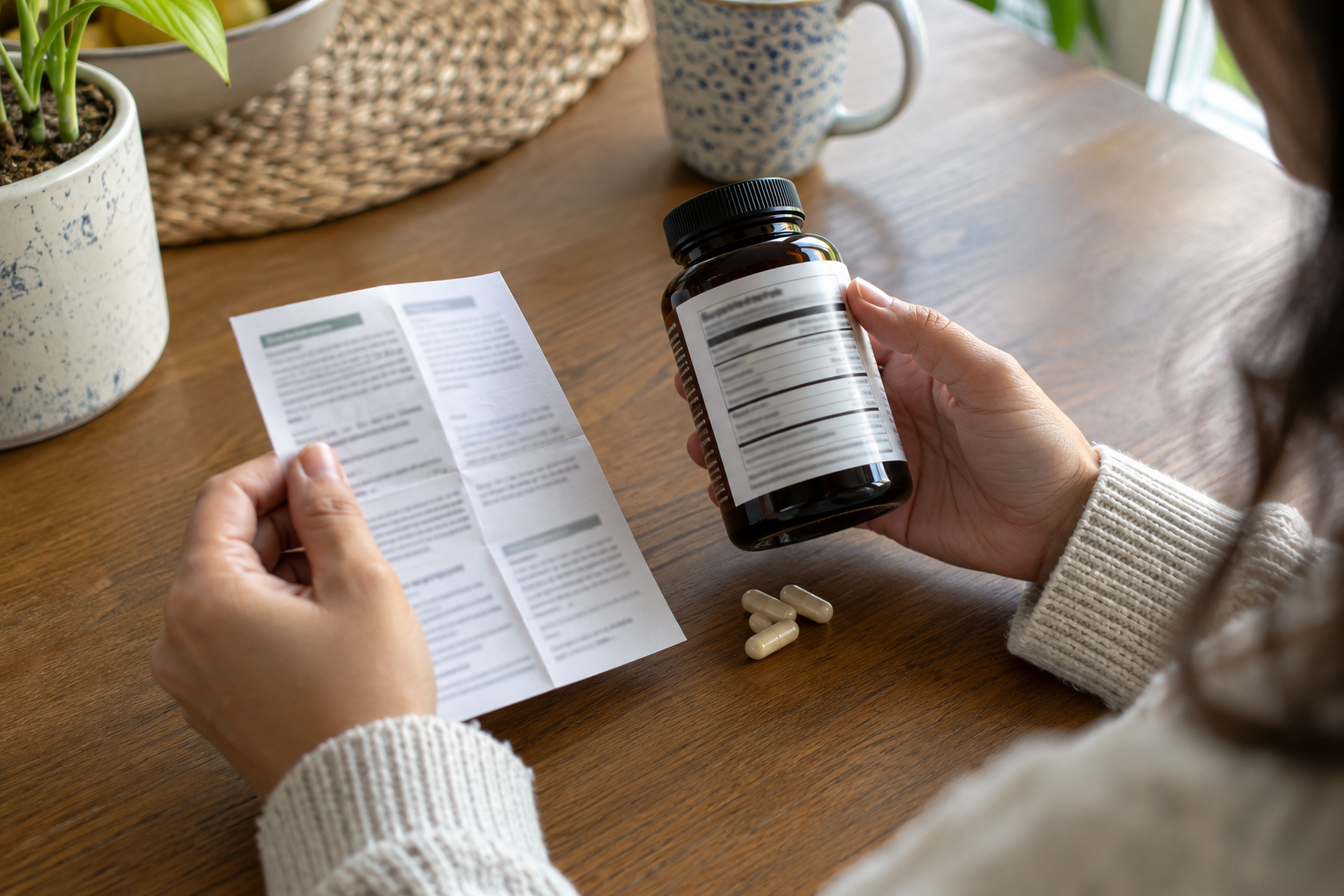
First identify the unit attached to the number. “500 mg per capsule” describes the amount in one capsule. “500 mg per serving” describes the amount in the serving size printed on the label, which might contain one capsule or several. A study may report milligrams per day, while a product name may advertise the total milligrams in the whole bottle. Those numbers cannot be compared until they use the same basis.
Use this sequence when reading a package: amount of NMN per unit, number of units per serving, number of servings per day in the directions, and total servings per container. If a formula includes resveratrol, PQQ, or other ingredients, check whether the front-panel number refers to NMN alone or to a blend. A large bottle total is not a daily amount.
| Label field | What it tells you | Do not confuse it with |
|---|---|---|
| NMN per capsule | The amount in one unit. | The amount in the full serving or day. |
| NMN per serving | The amount across the stated serving size. | A clinical dose that has been shown to suit every user. |
| Suggested servings per day | The product directions used to estimate days per bottle. | A personalized medical instruction. |
| Total NMN per bottle | The amount across all units in the container. | The daily serving or evidence of higher effectiveness. |
For a current product example, AIDEVI’s NMN 18000 product page lists 300 mg per capsule, 600 mg per two-capsule serving, 60 capsules per bottle, and 30 servings. The “18,000 mg” name refers to total NMN in the bottle, not one serving. The same page lists additional ingredients, so its full price is not the price of NMN alone. Read the current AIDEVI NMN 18000 product details and physical label for the latest information; this example explains label arithmetic, not what dose you should take.
What amounts have NMN human studies tested?
The useful question is not “Which number won?” It is “What exactly did researchers give, to whom, for how long, and what did they measure?” The examples below differ in study design and cannot be treated as a direct ranking of retail products.
| Research protocol | What was studied | What the result cannot tell you |
|---|---|---|
| 250 mg per day for 12 weeks | A randomized trial enrolled 30 healthy adults, with 15 assigned to NMN and 15 to placebo. Researchers reported higher whole-blood NAD+ in the NMN group under that protocol [1]. | That 250 mg is the ideal amount for every person, product, age, or health goal. |
| 300, 600, or 900 mg per day for 60 days | An 80-person dose-ranging trial in healthy middle-aged adults measured blood NAD+ as its primary outcome, alongside selected secondary outcomes [2]. | That the highest amount is best, or that findings from one preparation prove the same effect for another formula. |
| A single 500 mg administration | A small non-randomized study monitored 10 healthy men after single oral amounts of 100, 250, and 500 mg, with measurements over five hours [3]. | That 500 mg every day for weeks or months has the same evidence as a one-time dose. |
| 2,000 mg per day for 28 days | A 30-participant monitored physiological study used a specific microcrystalline NMN preparation in overweight or obese adults aged 45 and older [5]. | That a high research protocol is a consumer recommendation, a long-term safety finding, or a reason to increase a product serving. |
A 2026 systematic review of oral NMN or NMN-related preparations reported that trial amounts ranged from 250 to 2,000 mg per day and study periods from 14 days to 24 weeks. The trials varied in formulation, population, and outcomes; pooling a range does not establish one best dose or show that a higher label amount produces a better result [4]. AIDEVI’s NMN human-research and safety overview explains the difference between a biomarker result and a proven health outcome.
Does a higher research dose mean better value?
No. A higher amount can raise the NMN quantity in a serving or in a research protocol. It does not, by itself, establish more benefit, better quality, or better value for a particular shopper. In the dose-ranging trial, researchers evaluated one formulation, one adult population, a 60-day window, and selected endpoints. The study was not a head-to-head test of every 250 mg and 500 mg product on the market.
Likewise, a trial reporting short-term tolerability in selected participants does not answer long-term questions for all people. A 2,000 mg/day protocol involved a specific product and close study monitoring. It should not be used to override a product label or a clinician’s advice. If an advertisement says “more NMN means faster results,” ask which clinical outcome and which direct comparison support that sentence.
Customer reviews can help identify practical questions. The eBay and Reddit signals in this topic include cost per milligram, capsule size, sleep changes, and concern about taking too little. They are reports of individual experience, not controlled evidence that a dose caused a benefit or symptom. AIDEVI’s guide to why NMN feels different from person to person is useful when comparing a review with a clinical study.
How can you calculate NMN cost per month?
Compare the cost at the product’s stated serving directions, not by assuming you will take a different amount to match a study. Start with the current bottle price, the number of servings in the container, and the number of servings per day on that product’s label. Include shipping and tax separately if they change your delivered cost.
Labeled days per bottle = servings per container ÷ servings per day stated on the label.
Estimated 30-day cost = current bottle price × 30 ÷ labeled days per bottle.
Cost per 100 mg of NMN = current bottle price × 100 ÷ total NMN milligrams in the bottle. This is a quantity comparison, not a measure of clinical value.
Here is a math-only example, not a recommendation or a real-product price comparison. Imagine Product A contains 250 mg per capsule, 60 capsules, costs $30, and its label says one capsule per day. Product B contains 500 mg per capsule, 30 capsules, costs $24, and also says one capsule per day. Each bottle contains 15,000 mg total NMN. At those hypothetical directions, A lasts 60 days and costs about $15 per 30 days; B lasts 30 days and costs $24 per 30 days. B has the lower cost per 100 mg ($0.16 versus $0.20), but the higher monthly outlay. That is why bottle total, unit cost, and monthly cost answer different shopping questions—and none tells you which serving is right for you.
Using the AIDEVI product-page example above, 30 labeled servings at one serving per day represent 30 days. If the current bottle price is P, the estimated 30-day product cost is P before shipping and tax, and cost per labeled serving is P ÷ 30. With 18,000 mg total NMN per bottle, the arithmetic cost per 100 mg is P ÷ 180. Check the live shop price at the time you compare; it can change. Because this is a multi-ingredient formula, that calculation cannot assign the entire price to NMN or tell you whether the formula is clinically better.
For powder or products with more than one labeled serving per day, use the same formula with the actual serving count and directions. A lower price per 100 mg may look attractive but leaves out quality testing, other formula ingredients, storage, shipping, and whether the product’s directions fit your routine. Cost calculations help compare package economics; they do not decide how much you should take.
What should you verify before comparing products?
Use this buyer check before treating two numbers as comparable. If one answer is missing, ask the seller or pause the comparison rather than filling in the gap with the front-panel headline.
| Check | Write down | Why it matters |
|---|---|---|
| Dose basis | mg per unit, serving, day, and full bottle. | Stops a capsule amount from being mistaken for a daily total. |
| Study match | Study formulation, population, duration, and measured endpoint. | A study dose is only informative in its tested context. |
| Bottle economics | Current price, servings per bottle, days at label directions, and delivered cost. | Total bottle milligrams do not show the monthly cost. |
| Formula and quality | Other active ingredients, lot details, and what any test report actually tested. | One raw-material report may not represent the finished serving. |

For quality documentation, check whether the report identifies the product or sample, lot, test method, units, and result. AIDEVI’s guide to reading an NMN certificate of analysis explains why a purity percentage, identity result, and amount per serving answer different questions. A COA does not establish that a given dose is effective for you.
If you are comparing a routine over time, keep the product, label directions, and main outcome clear in your notes. AIDEVI’s NMN before-and-after tracking guide offers a way to record context without treating a single good or bad day as proof. Do not increase a serving just because a study used more NMN or because you do not notice an immediate change.
For personal dose questions, medication use, pregnancy or nursing, a medical condition, or a persistent reaction, ask a qualified healthcare professional. Review AIDEVI’s NMN safety and possible side-effects guide for general context. Clinical protocols, online comments, and a label calculator cannot replace individual medical advice.
Conclusion
A fair NMN comparison separates three decisions: what human studies tested, what a product label instructs, and what the product costs at those directions. Check whether 250 mg or 500 mg is per capsule, per serving, per day, or per bottle. Then calculate labeled days and cost per 30 days. Higher study doses show what researchers investigated under specific conditions; they do not identify a universal best dose or justify changing your own serving.
Frequently Asked Questions
Is 500 mg of NMN a high dose?
The number alone is not enough. It could mean one capsule, a multi-capsule serving, a total daily amount, or a one-time research dose. Identify the unit and frequency first. There is no universal “high” threshold in this comparison that can determine an individual’s appropriate amount.
Does a 500 mg capsule mean 500 mg per day?
Not necessarily. It states the amount per capsule only if the label says “per capsule.” Check the serving size and directions to see how many capsules make a serving and how often the label says to use it.
Is 500 mg better than 250 mg?
Human studies have used different amounts, but study-to-study differences in formulation, participants, duration, and outcomes prevent a simple product ranking. A higher milligram number is not by itself proof of better clinical value.
How do I compare monthly cost?
Divide the bottle price by the number of labeled days per bottle, then multiply by 30. Use the serving directions on that product, and account for shipping and tax. Cost per 100 mg is a separate quantity comparison, not a measure of effectiveness.
Can I copy a higher dose from a clinical study?
No study table can determine your personal dose. Research amounts are tested under controlled protocols in selected groups and for limited periods. Follow the exact product label and ask a qualified healthcare professional about personal questions.
References
- [1] Okabe K, et al. Oral Administration of Nicotinamide Mononucleotide Is Safe and Efficiently Increases Blood Nicotinamide Adenine Dinucleotide Levels in Healthy Subjects. Frontiers in Nutrition. 2022;9:868640.
- [2] Yi L, Maier AB, Tao R, et al. The efficacy and safety of β-nicotinamide mononucleotide supplementation in healthy middle-aged adults: a randomized, multicenter, double-blind, placebo-controlled, parallel-group, dose-dependent clinical trial. GeroScience. 2023;45:29–43.
- [3] Irie J, et al. Effect of oral administration of nicotinamide mononucleotide on clinical parameters and nicotinamide metabolite levels in healthy Japanese men. Endocrine Journal. 2020;67(2):153–160.
- [4] Yang W, Huang J, Tang Z, Chen C, Sun Y. Safety and Metabolism-Related Outcomes of Oral Nicotinamide Mononucleotide Supplementation in Adults: A Systematic Review and Meta-Analysis. Nutrients. 2026;18(14):2251.
- [5] Pencina KM, et al. Nicotinamide Adenine Dinucleotide Augmentation in Overweight or Obese Middle-Aged and Older Adults: A Physiologic Study. The Journal of Clinical Endocrinology & Metabolism. 2023;108(8):1968–1980.
This article is for general educational purposes only and is not medical advice. These statements have not been evaluated by the Food and Drug Administration. This product is not intended to diagnose, treat, cure, or prevent any disease. Consult a qualified healthcare professional before starting any new supplement, especially if pregnant, nursing, taking medication, or managing a medical condition.
