








AIDEVI Wellness Guide
nmn Certificate of Analysis: How to Read a COA Before You Buy
An NMN certificate of analysis (COA) is useful only when you can connect the report to the product and sample you care about. Start with the product and lot, identify whether the lab tested raw material or finished capsules, then read the method, specification, result, units, and test limits together. A COA can inform a quality decision; it cannot prove that NMN works or that a supplement is right for you.
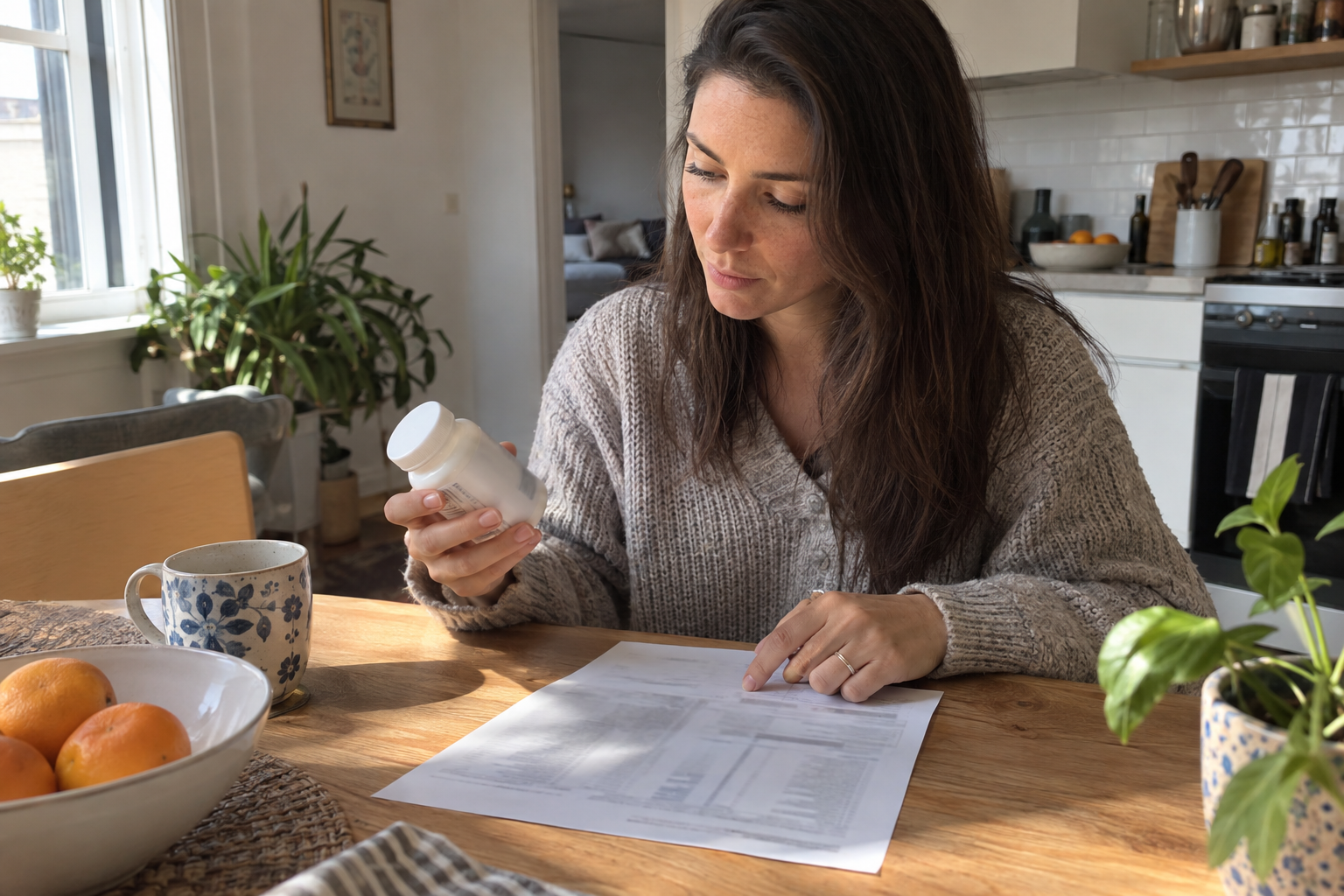
- Match the report to the product, sample type, and lot before interpreting a result.
- Identity, assay or strength, purity, and contaminant testing answer different questions.
- A lab name or “third-party tested” claim is not enough; check methods, scope, limits, and actual results.
- A COA is quality documentation, not proof of clinical benefit, universal safety, or FDA approval.
Content
- What does an NMN COA show?
- Was the sample raw NMN or the finished product?
- Which fields should you read first?
- How do you match a COA to your bottle?
- How are identity, assay, strength, and purity different?
- How should you assess the lab, method, and contaminant panel?
- What should you verify before buying?
- Frequently Asked Questions
What does an NMN COA show?
A Certificate of Analysis is a report of selected tests or examinations on a particular sample. Depending on its scope, an NMN COA may address whether a sample was identified as NMN, how much target material was measured, or whether named contaminants were below specified limits. It is not automatically a complete review of every quality attribute. The title “Certificate” also does not mean a government agency certified the product.
Read a COA as a chain of evidence: which product was sampled, what test was performed, what result was measured, and what comparison supports the conclusion? If one link is missing, the report may still contain useful information, but it answers a narrower question than the headline suggests. A single “Pass” or a large purity percentage cannot replace the underlying details.
Quality results do not answer which NAD+ support ingredient to choose. AIDEVI’s NMN-versus-NAD+ comparison examines that separate decision without treating a COA as clinical evidence.
Was the sample raw NMN or the finished product?
This is one of the most consequential details on the page. A raw-material report describes an ingredient before it is blended, encapsulated, packaged, or stored as the consumer product. A finished-product report describes the final format, such as the capsule or powder sold. Both can support quality controls, but one cannot silently stand in for the other.
If a report tests a raw ingredient, it does not by itself show the measured amount in each finished serving, how the ingredient was handled during production, or which contaminants were tested in the final product. If a report tests the finished formula, check whether it identifies the product format and lot, and whether the test scope includes the attribute you want to verify. The sample description matters as much as the test result.
U.S. dietary supplement cGMP rules distinguish ingredient controls from finished-batch verification. Under 21 CFR 111.75, manufacturers generally must test the identity of dietary-ingredient components before use, unless FDA grants an exemption. Finished-batch specifications are verified on a statistically selected subset or every batch, with quality-control review. For other components, a manufacturer may rely on a supplier COA only after confirming supplier reliability, checking methods, limits and actual results, keeping qualification records, periodically reconfirming reliability, and obtaining quality-control approval. These are manufacturer obligations; they do not require a public COA for every bottle. A supplier-issued report also does not automatically mean independent testing [1].
Which fields should you read first?
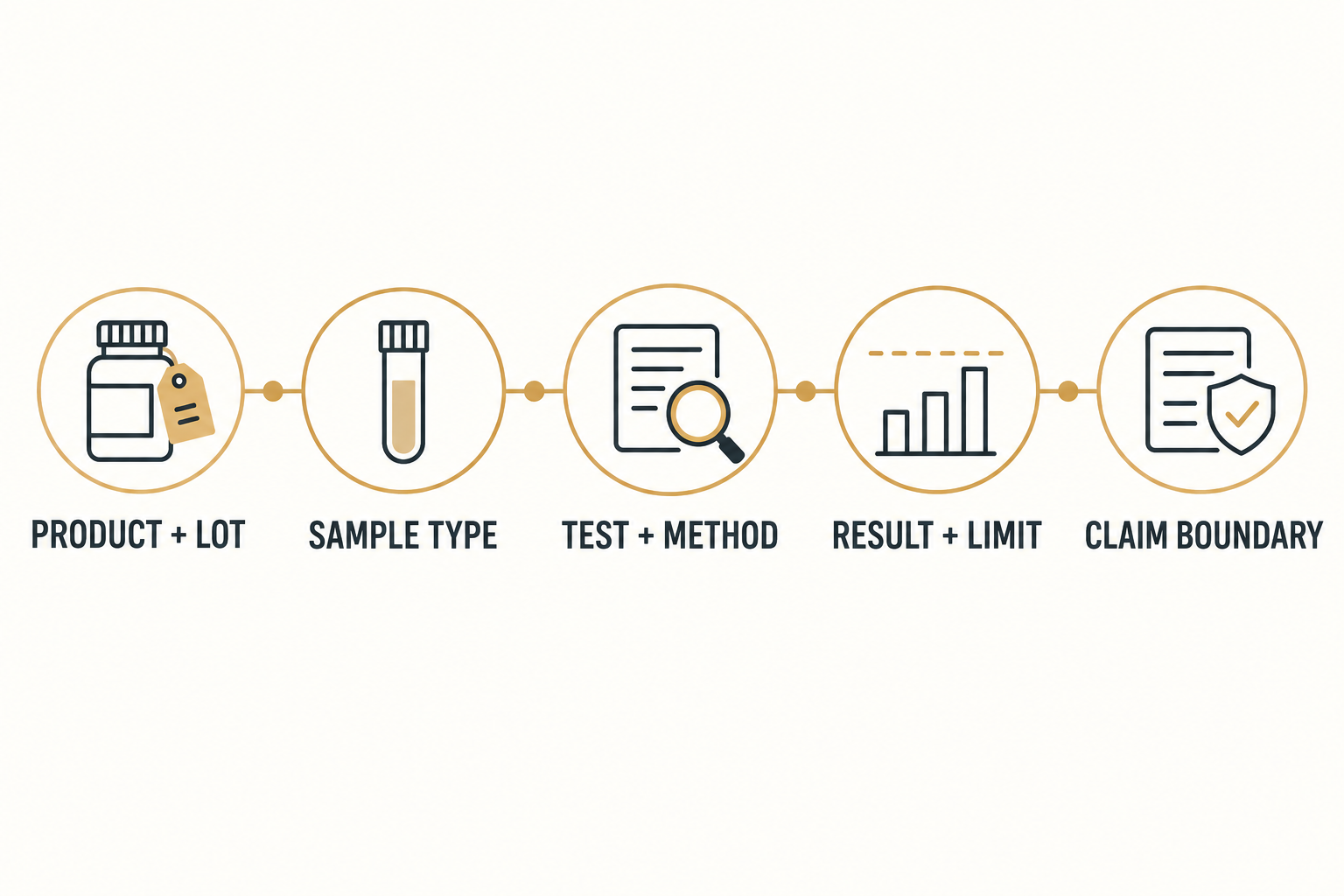
Use this five-part route before judging whether a COA is persuasive. It follows the document from product identity to the boundary of what the result can support.
| Check | What to look for | Question it answers |
|---|---|---|
| Product + lot | Product name or code and a lot/batch identifier | Can I connect this report to the item I am evaluating? |
| Sample type | Ingredient, blend, capsule, powder, or other tested material | Which step in production does this result describe? |
| Test + method | Test name and a named or referenced method | What was measured, and how? |
| Result + limit | Actual result, unit, specification, and any detection or quantitation limit | What does the number mean against the stated criterion? |
| Claim boundary | Which properties were tested and which were not | What conclusion is reasonable, and what remains unknown? |
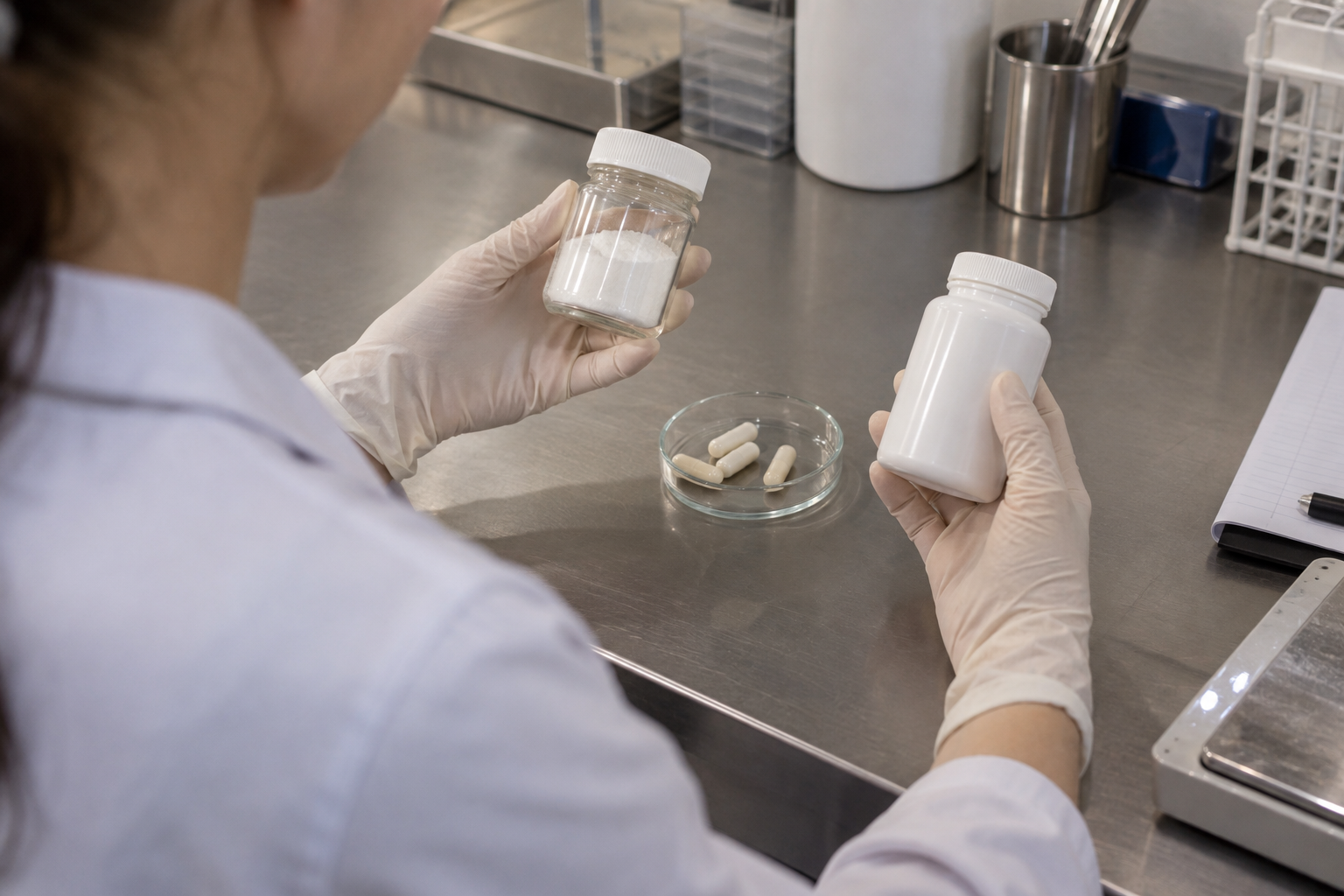
Check sample/test and report dates and how the sample was selected. A recent report can still be irrelevant if it tests the wrong material or an unlinked lot. If sample selection or lot connection is unclear, ask the company.
How do you match a COA to your bottle?
Use the same order when checking a report online or asking support for one. The goal is to connect the tested sample to the product you can actually buy.
- Find the lot code on the bottle, label, base, cap area, or outer carton.
- Find the report's lot, batch, or sample identifier.
- Compare codes exactly. If one identifies an ingredient lot, ask how it maps to the finished-product lot.
- Confirm the product name, format, and serving description match what is sold.
- Read the sample receipt, test, and report dates for a plausible batch timeline.
- Check the laboratory and report source; ask the company to explain any missing link.
How are identity, assay, strength, and purity different?
These terms are related, but they are not synonyms. A useful report states which attribute each result addresses rather than using one attractive number to imply that every quality question has been answered.
- Identity: whether the tested material is the ingredient it is represented to be. A clear identity result is a different question from how much of that material is present.
- Assay or strength: the measured amount of a target component, reported on a stated basis. Check whether the sample is raw powder or finished product, whether the number is per gram, capsule, or serving, and how that basis relates to the label.
- Purity: a description of the target material relative to other measured or detected components under a method. Ask how the percentage was calculated. A chromatographic area percentage, a weight-based result, and milligrams per serving are not automatically interchangeable.
Compare like with like: raw-powder percentages, per-capsule milligrams, and per-serving label amounts use different bases. Even a 99% raw-material result does not measure the NMN delivered by a finished capsule. AIDEVI’s NMN dosage guide discusses serving choices; it cannot substitute for product-specific assay data.
A specification is the acceptance criterion; a result is the measured value. A “Pass” without the actual result, unit, method, or limit is hard to evaluate. Ask who set the specification and whether it applies to this sample—do not assume it is a universal FDA threshold.
How should you assess the lab, method, and contaminant panel?
“Third-party tested” is a starting point. Check the lab, who submitted the sample, methods, and whether it tested the finished product or only a supplier’s ingredient. Independence does not fix an untraceable sample or irrelevant test.
If a laboratory cites ISO/IEC 17025 accreditation, verify the accrediting body and the scope. Accreditation is relevant to the activities listed in a lab’s scope; it does not mean every test the laboratory performs, every ingredient, or every report is automatically accredited. Look for a match between the named test or method and the scope before treating the accreditation mark as evidence for that specific result [3]. Measurement traceability and reference standards also matter when a report makes a quantitative claim [4].
For contaminants, read the analytes one by one. A report may include selected heavy metals, microorganisms, residual solvents, or other tests based on the material and process. The phrase “screened for contaminants” does not tell you which substances were included, what limits were used, or whether the tested sample was the finished product. A panel is meaningful only in relation to the actual product and its relevant risks.
Check units and method limits. “Not detected” does not necessarily mean absolute zero; it can mean the target was not detected above the method’s stated limit. “Below the limit of quantitation” means the method did not quantify it at that level, which is not the same as proving absence. Ask for the reporting limit if it is important to your decision. Compare results only when the analyte, sample type, units, method, and limit are comparable.
FDA does not pre-approve supplements for safety or effectiveness; companies remain responsible for applicable requirements [2]. NIH says quality seals do not guarantee safety or effectiveness [5]. Neither seals nor COAs establish NMN’s health effects or suitability for every person.
What should you verify before buying?
Use the report to decide what to do next. Missing details justify focused questions; they are not proof that a product is counterfeit or unsafe.
| Continue reviewing | Ask the company | Pause until clarified |
|---|---|---|
| Product, sample type, and lot are traceable. | How does an ingredient lot map to the finished lot? | The report identifies no product, sample, or lot. |
| Relevant tests show methods, units, limits, and actual results. | Which identity, amount, or contaminant tests were omitted? | Only a large purity claim or unexplained “Pass” is shown. |
| The laboratory and scope can be checked. | Was this supplier testing or testing by an outside lab? | A badge is presented as FDA approval or proof of health outcomes. |
These gaps limit what the report can support; they do not alone prove fraud or danger.
If a public report is not available, ask customer support for the product name, lot number, sample type, test panel, and report date. AIDEVI’s Lab Reports & Manufacturing Standards library explains that documentation may vary by product and batch and provides a route to search or request information. Start with the current AIDEVI NMN product information, then compare any available report with the specific package and lot. Availability should not be assumed for a product or batch unless the documentation confirms it.
For expectations beyond lab quality, AIDEVI’s guide to why NMN feels different explains how product details and personal context affect interpretation. A batch report cannot predict a personal result.
Conclusion
A useful NMN COA lets you trace a result to a product, sample, lot, method, and stated specification. Read identity separately from assay or purity, distinguish raw-material tests from finished-product tests, and check exactly which contaminants were assessed. A clear report can support a quality review, but it is one piece of evidence. It cannot establish clinical effectiveness, guarantee safety for every user, or mean the FDA approved the supplement.
Your next step
Find the lot code on the product you are considering. Then use the AIDEVI quality-document library or contact the company with that product and lot information to ask which report, if available, applies.
Frequently Asked Questions
Does a high NMN purity percentage prove the product is high quality?
No. First confirm identity, sample type, method, units, and how the percentage was calculated. A raw-material purity figure is not the same as the measured amount in a finished serving, and it does not describe contaminants or clinical results by itself.
Does every NMN bottle need its own public COA?
Do not assume that a public downloadable certificate is required for every bottle. U.S. cGMP rules describe manufacturer controls and finished-batch verification using a sound sampling plan or testing each batch. Ask the company how a report connects to the lot you have; the regulation does not make every COA a consumer-facing label document.
Is third-party tested the same as independently certified?
Not necessarily. “Third-party tested” says an outside lab may have performed a test, but you still need the laboratory name, sample source, test scope, method, and result. Certification and laboratory accreditation are separate claims; verify their scope and do not treat a logo as a substitute for the report.
Does a COA prove that NMN is safe or effective?
No. A COA can report selected quality measurements on a sample. It does not show that NMN will improve a health outcome, establish long-term safety for every person, or replace advice from a qualified healthcare professional.
What does “not detected” mean on a contaminant test?
It means the named test did not detect the analyte at or above the method’s stated reporting threshold. It does not always mean the substance is absolutely absent. Check the method, unit, and detection or quantitation limit before comparing reports.
Should I use a COA to choose an NMN serving amount?
No. A COA is not a dosing recommendation. Read the current product label and use AIDEVI’s NMN dosage guide for general serving questions, then consult a qualified professional about your personal circumstances.
References
- [1] Electronic Code of Federal Regulations. 21 CFR § 111.75: What must you do to determine whether specifications are met? Current eCFR reviewed September 2026.
- [2] U.S. Food and Drug Administration. FDA 101: Dietary Supplements.
- [3] A2LA. Frequently Asked Questions: Laboratory Accreditation and Scope.
- [4] National Institute of Standards and Technology. Metrological Traceability Frequently Asked Questions and NIST Policy. NIST Technical Note 2156.
- [5] NIH Office of Dietary Supplements. Dietary Supplements: What You Need to Know.
Disclaimer: These statements have not been evaluated by the Food and Drug Administration. This article is for general educational purposes only and is not intended to diagnose, treat, cure, or prevent any disease. It is not medical advice. Consult a qualified healthcare professional before starting a new supplement, especially if pregnant, nursing, taking medication, or managing a medical condition.
